
Resources

Greenhouse Gas (GHG) Emissions Sectoral Guidance and Carbon Footprint Questionnaire
Suppliers play an important role across the whole self-care value chain, including the cultivation and process of raw materials, packaging and material production, and transportation and distribution. At each point along the value chain, the choices of suppliers, producers, and customers impact the GHG footprint of the self-care industry.
This document is intended to be a simplified supplemental guidance for suppliers to the self-care industry, to be used in combination with global GHG other reporting protocols (e.g., WBCSD-WRI, corporate value chain accounting and reporting standard, product life cycle accounting and reporting standard and SBTI), for developing a GHG reduction strategy.
The aim is to provide suppliers with non-technical guidance and practical examples for calculating an accurate baseline GHG emissions footprint, establishing a broader climate change and decarbonization strategy, and quantifying the GHG footprint consistently over time to measure and transparently report progress. This document is complemented by the GSCF Carbon Footprint Questionnaire provided to assess and report on the environmental and social impacts of pharmaceutical suppliers' practices.
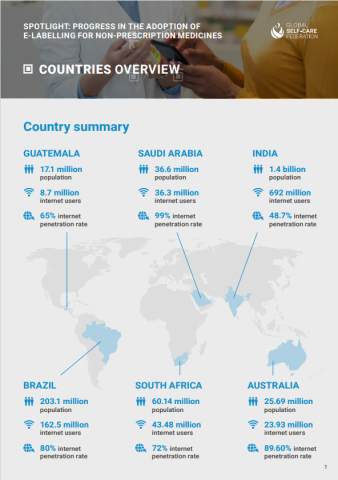
Countries Overview: Spotlight on Progress in the Adoption of E-labelling for Non-prescription medicines
These documents highlights the advances made by countries in different regions globally towards adoption of E-labelling for Non-prescription medicines.

Self-Care Readiness Index Report 2.0
The Self-Care Readiness Index report assesses countries' self-care systems across four critical enablers, and ranks them intuitively from 1 to 4, with 4 being the most resilient self-care system. The countries studied in the first edition of the index are: Brazil, China, Egypt, France, Nigeria, Poland, South Africa, Thailand, United Kingdom and United States.