Home

Main navigation

  • Who we are
    • About Self-Care
      About Self-Care
    • Collaboration
      Collaboration
    • Become a Member
      Become a Member
    • Our Organisation
      • GSCF Committees
      • Our Members
      • Our Board Members
      • Our Team
      • Code of Ethics
  • Initiatives & Impact
    • Evidence Based Self-Care
      Evidence
    • WHO Engagement
      Resolution
    • Regulatory Affairs
      Regulatory
    • Environmental Sustainability
      Env Sustainability
    • Policy Work
      Policy
    • Our Impact
      Impact
  • International Self-Care day
  • News
  • Events
  • OTC Handbook
  • Resources

Breadcrumb

  1. Home
  2. Publication

GSCF Reliance Pandemic Paper

Pandemics emerge and escalate when transmission accelerates, detection is delayed, trusted risk communication is weak, and health systems become overwhelmed. COVID-19 demonstrated that a large share of mild and moderate illness is managed outside hospitals and formal clinical settings, while WHO guidance also emphasised safe home care for appropriate cases and clear referral pathways when symptoms worsen. Self-care should therefore be treated as a core component of pandemic prevention, preparedness and response (PPPR), not as a peripheral consumer-health issue.

Image

GSCF Charter for Environmentally Sustainable Self-Care: 2025 Progress Report

This year marks the fourth anniversary of the launch of GSCF’s Charter for Environmentally Sustainable Self-Care, the first climate action resolution from the consumer health sector.

Image

Self-Care Socio-Economic Research 2026: Self-Care Can Unlock 50% More Economic and Societal Benefits by 2040

Responsible self-care, a complementary pillar of strong health systems, empowers individuals to stay healthy, prevent disease and manage illness effectively, supporting longer, healthier and more productive lives. 

Image

GSCF 2025 Impact Report

This Impact Report reflects a year of meaningful progress and transition for the Global Self-Care Federation (GSCF), as we advanced our mission to position self-care as an essential pillar of resilient, person-centred health systems worldwide. Guided by the launch of our 2025–2028 Strategy, the Federation strengthened its foundations, expanded its global engagement, and delivered concrete impact across policy, regulatory, and partnership priorities.

Image

Unlocking Self-Care for Global Health Progress - 2025 Update

2025 has been a turning point for self-care. Around the world, policymakers are looking for ways to keep health systems strong despite workforce shortages, rising costs, and the growing impact of ageing and noncommunicable diseases (NCDs). 

Empowering people to care for their own health  is no longer optional; it is one of the smartest,  most practical solutions we have. This update builds on last year’s inaugural report 1 and captures the momentum of a year that brought renewed focus on prevention, primary care, and digital health innovation. 

Role of Real-World Data and Real-World Evidence for Self-Care Products

Role of Real-World Data and Real-World Evidence for Self-Care Products

Real-World Data (RWD) and Real-World Evidence (RWE) not only play an increasingly significant role in the pharmaceutical sector, but also the consumer health industry.

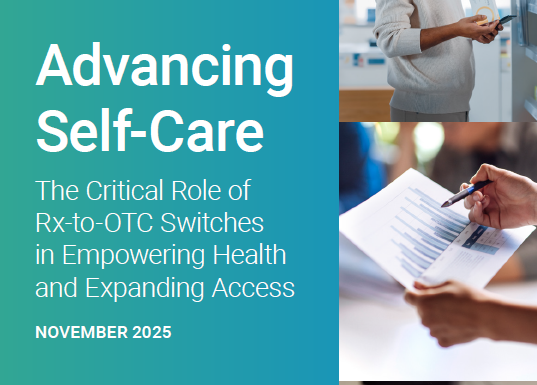
9_12_25_The Critical Role of Rx-to-OTC Switches in Empowering Health and Expanding Access

The Critical Role of Rx-to-OTC Switches in Empowering Health and Expanding Access

Self-care, as defined by the World Health Organization (WHO), is the ability of individuals, families, and communities to promote health, prevent disease, maintain health, and cope with illness and disability, with or without professional healthcare support.

This broad concept encompasses everything from healthy diets and mindfulness to non-prescription medications and self-monitoring of health conditions. 

Risk-based Regulatory Framework

Risk-Based Regulatory Framework for Non- Prescription Medicines

Self-care is a foundational element for achieving universal health coverage (UHC). Empowering individuals to manage minor ailments through appropriate self-care reduces pressure on health services and improves overall health outcomes, even as healthcare systems grapple with demographic shifts, rising chronic disease burdens, and limited resources. 

2021 charter

GSCF 2021 Environmental Progress Report

Creating an environmentally sustainable healthcare system doesn’t just reduce climate impact through fewer emissions, it brings improved health to the entire population. This sentiment was true one year ago at the launch of the Charter for Environmentally Sustainable Self Care and continues to ring true today. The impact climate change has on health has continued to be researched, analyzed, and understood. 

JOINT INC-5.2 STATEMENT: Advancing a Health-Centric Global Plastics Treaty Geneva

Switzerland | August 2025

As organisations dedicated to improving and protecting human and planetary health, Health Care Without Harm (HCWH), the Global Self-Care Federation (GSCF), and the International Federation of Pharmaceutical Manufacturers & Associations (IFPMA) call on Member States to prioritize approaches in the global plastics treaty that place human health at the heart of action to end plastic pollution.

Pagination

  • Page 1
  • Next page ››
Subscribe to Publication
Home

Global Self-Care Federation, +41223625384,

Spaces Nation, Chemin des Mines 2, 1202, Geneva, Switzerland

  • Twitter
  • LinkedIn
  • YouTube

Footer

  • About Self-Care
  • Members
  • Become a Member
  • News
  • Events
  • Resources
  • Newsletter
  • Privacy Policies
  • Environmental Sustainability Pledges
  • Member Initiatives
  • OTC Directory
  • Contact us

Footer second

  • Events

Keep up to date with latest events

Copyright © 2026 - Global Self-Care Federation - Some rights reserved.